top of page

ENRICHING THE ROANOKE-CHOWAN AREA
AND BEYOND
WILLIAM G. POMEROY MARKERS
The William G. Pomeroy Foundation provided grants to Chowan Discovery for the markers on this page. To learn more at https://www.wgpfoundation.org/

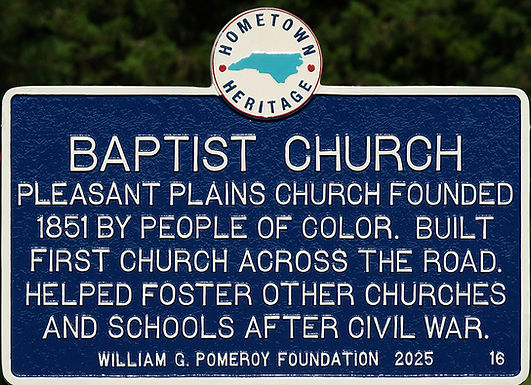
Founded in 1851, Pleasant Plains Church is the first institution of the Winton Triangle. One of its founders and the church’s first pastor of color were among the men who served in United States forces of color in the Civil War thus taking part in ending slavery. The church’s community fostered churches. Its members were leaders in the areas of education, business, agriculture, civic organizations, healthcare and Civil Rights.
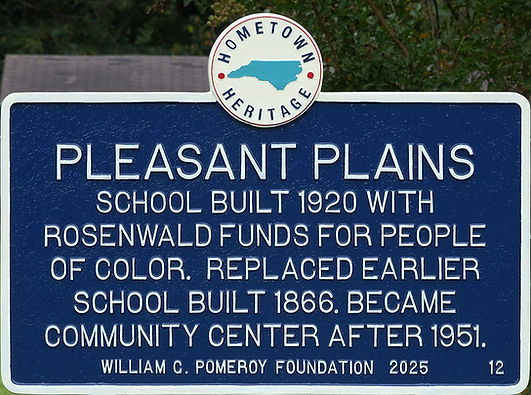
There is evidence that Pleasant Plains School existed as early as 1859. Some of its early students were the first in the area to seek higher education in the 1860s. The school is the parent school of the the area's first high school for people of color, Chowan Academy. The community, including church founders, built the first schoolhouse in 1866. It was replaced in 1920-21 by a Rosenwald funded building that is now on the National Register of Historic Places.
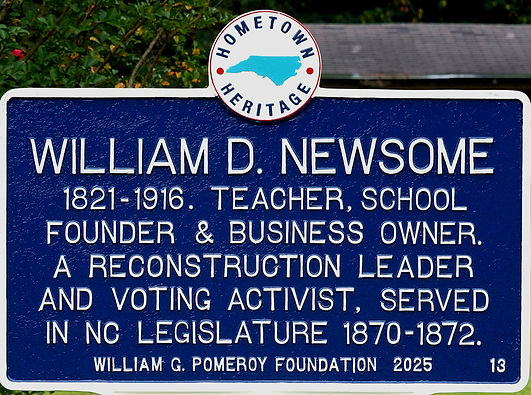
William David Newsome, who previously taught refugees at a freedmen's colony on the North Carolina coast, returned to his community to become the schoolhouse's first teacher. He mentored others who would teach at Pleasant Plains and other community schools, and he oversaw those schools as well. Newsome collected Freedmen's Bureau payments for these school and among was among the first people of color to serve in the North Carolina general assembly.
Augustus Robbins was descended from the first inhabitants of the Winton Triangle area, the Chowanokes. He served as a Quartermaster Sergeant in United States forces in the Civil War as well as a representative in the North Carolina House of Representatives. A businessman and community leader advocating for the rights of people of color, Robbins co-founded a church and a high school in Windsor, NC.

When people of color were not allowed to participate in a local fair, its leaders created a fair of its own. The Atlantic District Fair in Ahoskie, NC had agricultural, educational and public service exhibits; home, farm and art crafts, livestock and poultry, a carnival, a one-half mile harness racing track, performances and fireworks. It ran for over 90 years. The fairgrounds still see occasional use for the public.

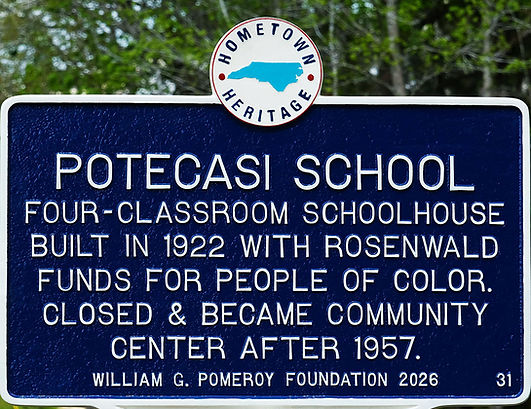
In April, 2026, we unveiled a new historical marker for the 124-year-old Potecasi Graded School in Potecasi, NC. This four-classroom Rosenwald School is one of 5,357 Black schools, shops, and teacher homes constructed between 1917 and 1932 in the United States, and other 800 in North Carolina. The school closed in 1957, and the schoolhouse became a community center that is still in service.
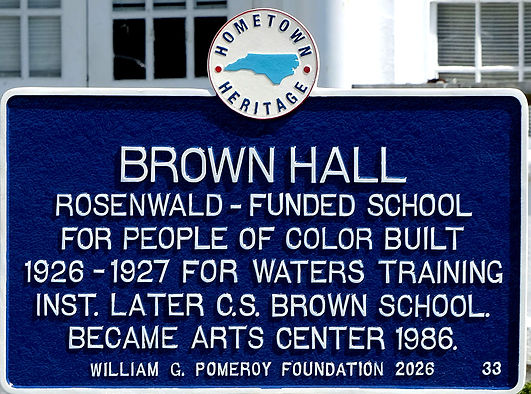
One of the centerpieces of the Winton Triangle is Brown Hall, a 10,000 square foot auditorium and classroom building that was funded by the community, the Rosenwald Fund and the county government. It is the center of the C.S. Brown School's historic multi-building campus. A bronze plaque from the Pomeroy Foundation denotes that Brown Hall is on the National Register of Historic Places. Brown Hall is the last of founding principal Dr. Calvin Scott Brown’s school structures.
With her Boston education, Lydia Warrick left her Philadelphia home to teach refugees at the Roanoke Island Freedmen's Colony in 1865. She later taught at what is now Riverview Elementary School and acquired Freedmen's Bureau funding for the school. As Hertford County's first accredited teacher of color, Warrick raised the level of education. She later tutored Annie Walden, Chowan Academy's first graduate.
Marker to be unveiled
later in Murfreesboro, NC.
bottom of page